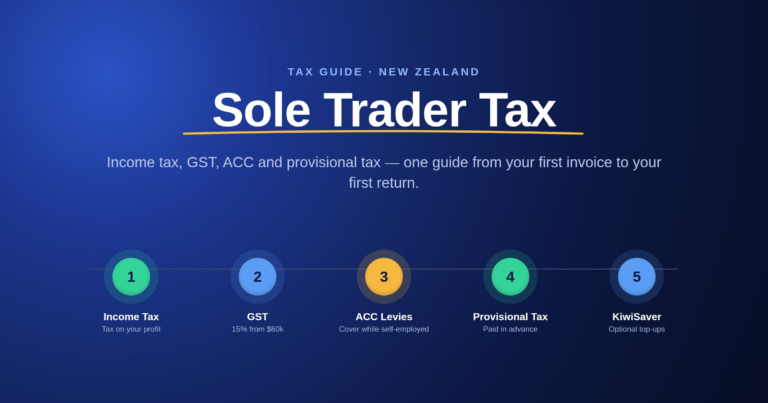
GST is a 15% tax added to most goods and services in NZ. If you’re a sole trader, whether you need to deal with it comes down to one number: $60,000. Here’s what registering actually means, what you can claim back, and the one trap worth knowing before you claim anything on your home.
1. Do you need to register? The $60,000 threshold
If your self-employed turnover hits (or you expect it to hit) $60,000 in any rolling 12-month period — not just a financial year — registration is compulsory. It can happen mid-year: the moment you cross the line, you’re required to register, even if you haven’t yet. Under $60,000, registration is optional.
2. What registering actually means, in practice
Once registered:
- You must add 15% GST on top of your existing prices for everything you sell — this isn’t optional or something you absorb yourself.
- You collect that 15% from your customers, but it was never really yours — you’re just holding it for IRD.
- At each GST return, you don’t hand over the full amount you collected. You net it against the GST you’ve paid on your own business expenses (“input tax”), and pay IRD the difference. If you paid more GST on expenses than you collected in a period, you get a refund instead.
✅ Generally claimable
- •Power, phone and internet used for the business
- •Business rent, stationery and consumables
- •Repairs to business assets
- •Vehicle running costs — petrol, WOF, rego (apportioned for private use)
- •Capital purchases: tools, equipment, a work vehicle
❌ Not (or only partly) claimable
- •Wages and salaries
- •Bank fees and loan interest
- •Anything bought from a private, non-GST-registered seller
- •Private drawings
- •Exempt supplies — residential rent, financial services, donations
- •Only 50% of client entertainment is claimable, matching the income-tax rule
3. Seeing it in practice — two example periods
A standard period: you’ve sold $10,000 (excl. GST) of services this period, collecting $1,500 in GST from customers (output tax). Your regular running costs — power, phone, materials, etc. — come to $3,333 (excl. GST), so you’ve paid $500 in GST on those (input tax), roughly a third of what you collected.
GST collected: $1,500 — GST claimed back: $500 → you pay IRD $1,000. That’s the ordinary shape of a return: you collect more than you claim, and the difference goes to IRD.
Same period, but you also buy a car: same sales, same running costs — but this period you also buy a secondhand car for $25,000 from a GST-registered dealer, at 80% business use.
- GST-exclusive price: $21,739.13 → GST paid: $3,260.87 → claimable at 80% business use: $2,608.70
- Total input tax this period: $500 (running costs) + $2,608.70 (car) = $3,108.70
- GST collected: $1,500 (unchanged) vs. GST claimed: $3,108.70 → IRD pays you $1,608.70.
4. The home-office trap
If you run your business partly from home, you can claim GST on the running costs apportioned to business use (a % of power, phone, rates, etc. based on the area/time used for work) — that part’s straightforward and safe.
Where it gets dangerous: if you ever claim GST on the purchase price of the house itself, or on a capital improvement (an extension, a built-in renovation, structural work), IRD’s current position is that this brings the entire house into the GST system — not just the business-use portion. If you later sell the house, GST becomes payable on the full sale price, even though you only ever claimed a small percentage. The same hits you on deregistering.
5. Choosing (and finding) your filing frequency
Once registered, you pick how often you file:
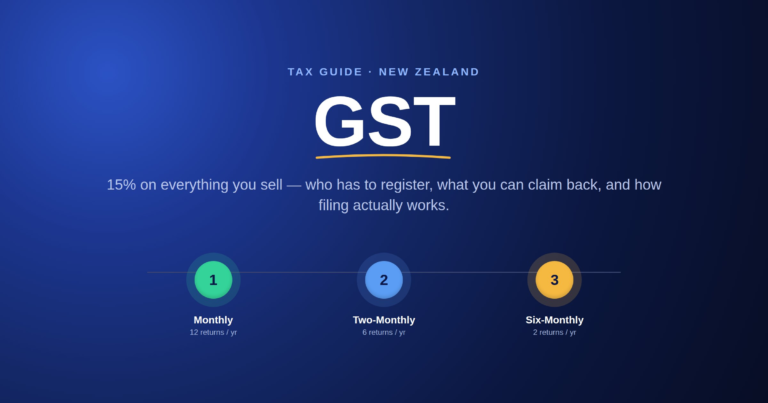
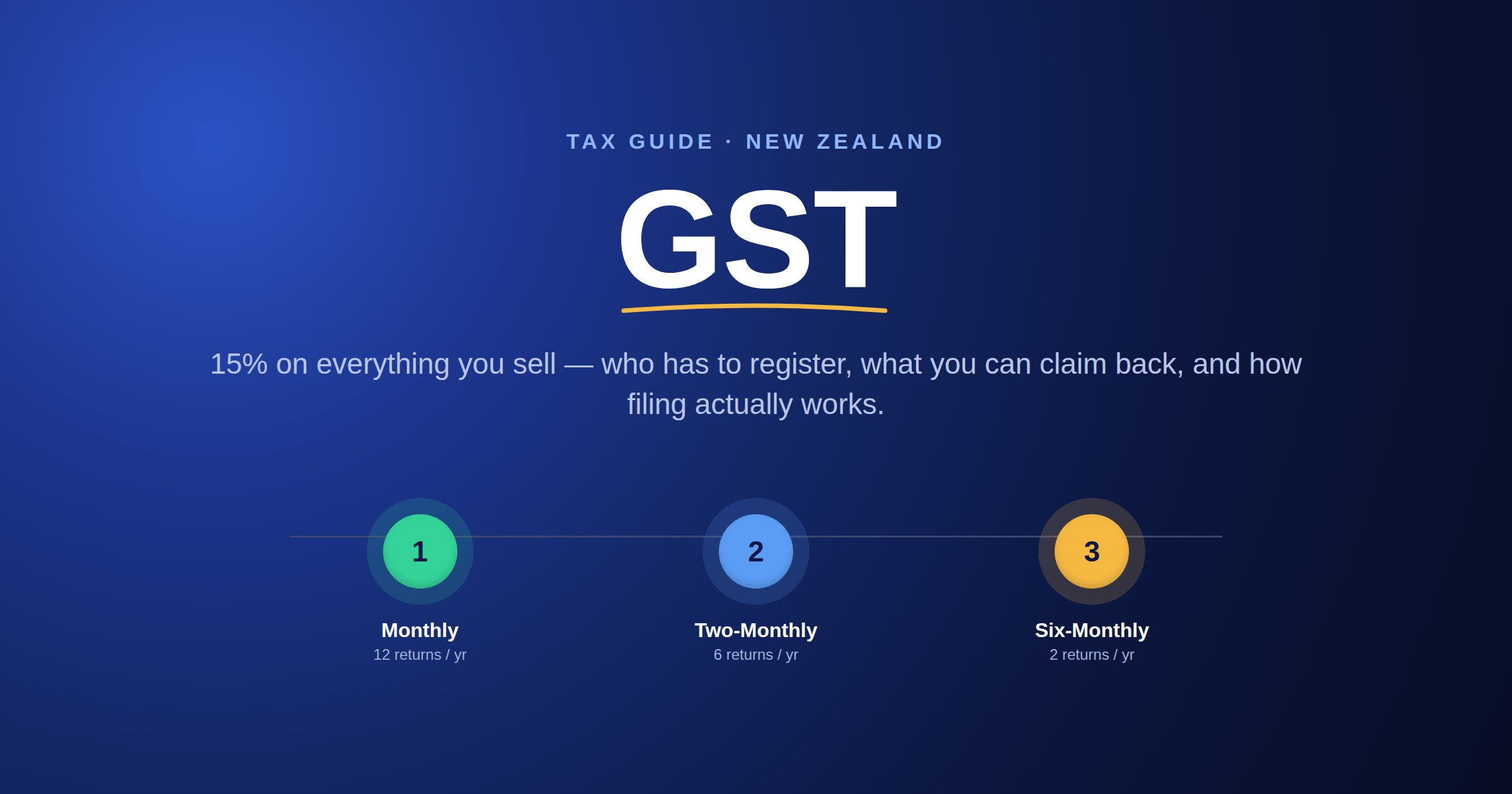
- Monthly — 12 returns a year. Only worth it if you’re regularly in a refund position and want your money back sooner.
- Two-monthly — 6 returns a year. The default for most small businesses; a practical middle ground.
- Six-monthly — just 2 returns a year, but only available if your turnover is under $500,000. Best fit for sole traders with low transaction volume.
Not sure what you’re currently set to? Log in to myIR, open your GST account, and check your account/registration information — it shows your current filing frequency and accounting basis (payments, invoice, or hybrid). To change it, use the “Change filing frequency or accounting basis” option in myIR; you’ll see your current setting before confirming a change. You can only move to a frequency you’re eligible for, and a change usually takes effect from your next taxable period, not retroactively.
6. When returns are due
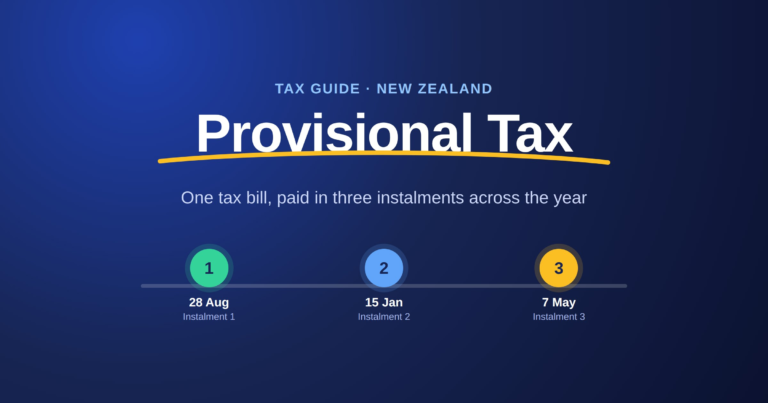
Generally the 28th of the month after your taxable period ends — with two exceptions: a period ending 30 November is due 15 January, and a period ending 31 March is due 7 May.
How Barnaby helps
Barnaby calculates output and input tax from the transactions you’ve already entered — sales, expenses, and any apportioned business-use purchases — so your GST position for the period is worked out for you rather than pieced together by hand. It tracks your filing frequency and due dates so a return date never arrives as a surprise, and if you also own a rental property, it sits alongside that in the same place instead of a separate system.
See it for yourself
Track your GST, income tax and ACC in one place, alongside a rental property if you have one.
Get startedWant the bigger picture first? Read the full Sole Trader Tax in New Zealand guide, which covers income tax, GST, ACC and provisional tax together.
This is general information, not personalised tax advice. Rates, thresholds and rules above are current as of September 2026, and they change most years — always check current figures at ird.govt.nz or with an accountant before relying on them for a real decision.