Provisional tax is the single most misunderstood part of going self-employed in New Zealand — not because it’s complicated, but because almost nobody explains it before it catches you. Here’s exactly what it is, when it’s due, and the trap that hits nearly every sole trader in year two.
1. What provisional tax actually is
Provisional tax isn’t a separate tax on top of income tax — it’s the same income tax you’d owe anyway, just paid in instalments during the year you earn the money, instead of as one lump sum after you file your return.
As an employee, PAYE does this invisibly out of every payslip. As a sole trader or contractor, nobody withholds anything for you by default (unless a client deducts withholding tax from your invoices) — so IRD asks you to pay estimated instalments yourself, based mostly on what you earned last year.
2. Who has to pay it — the $5,000 threshold
You become a provisional taxpayer once your residual income tax (RIT) — the tax you owed for a year, after subtracting anything already withheld (PAYE, withholding tax, etc.) — was $5,000 or more. That figure from your most recent return is what determines whether you pay provisional tax for the year ahead, and roughly how much.
Below $5,000 RIT, you just pay the full amount as one lump sum, by terminal tax day, and never touch provisional tax at all.
3. The first-year trap
This is the part almost nobody warns new sole traders about. In your very first year of contracting, IRD has no prior return to base an estimate on — so you owe no provisional tax at all that year. If your clients aren’t withholding tax either, every dollar you invoice can land with nothing held back, for twelve straight months.
Then your first year’s bill (terminal tax) falls due on 7 February the following year (7 April if you file through a tax agent’s extension). If that bill is $5,000 or more, two things happen on the very same day: you pay it in full, and it makes you a provisional taxpayer for year two — whose first instalment is often only weeks away, calculated at 105% of the bill you just paid.
Take Maia, a self-employed hairdresser in her first full year, netting $70,000. Her year-one terminal tax comes to around $14,600, due 7 February. That payment alone makes her a provisional taxpayer for year two, at roughly $15,330 (105% of it) split into three instalments — and because year two’s first instalment (28 August) had already passed before she even knew she owed anything, it’s often due alongside the terminal tax bill too. In a bad case, that’s two years of tax landing within days of each other, purely because nothing forced any of it to be set aside along the way.
4. Exactly when it’s due
The dates depend on how often you file GST — not on when your money actually comes in. All three schedules below assume the standard 31 March balance date almost every sole trader uses.
| You file GST… | Instalments | Due dates |
|---|---|---|
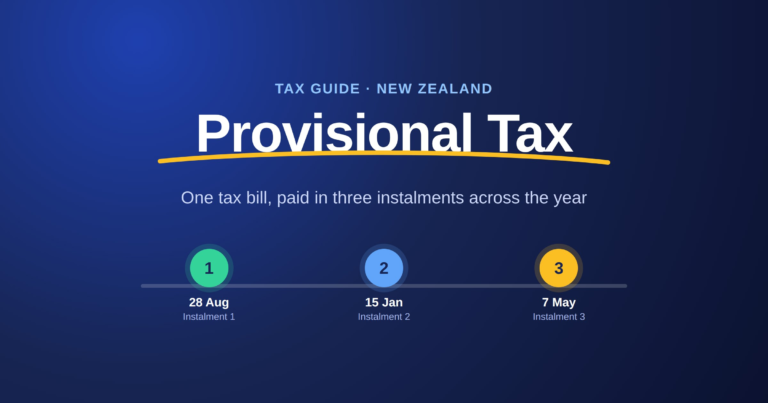
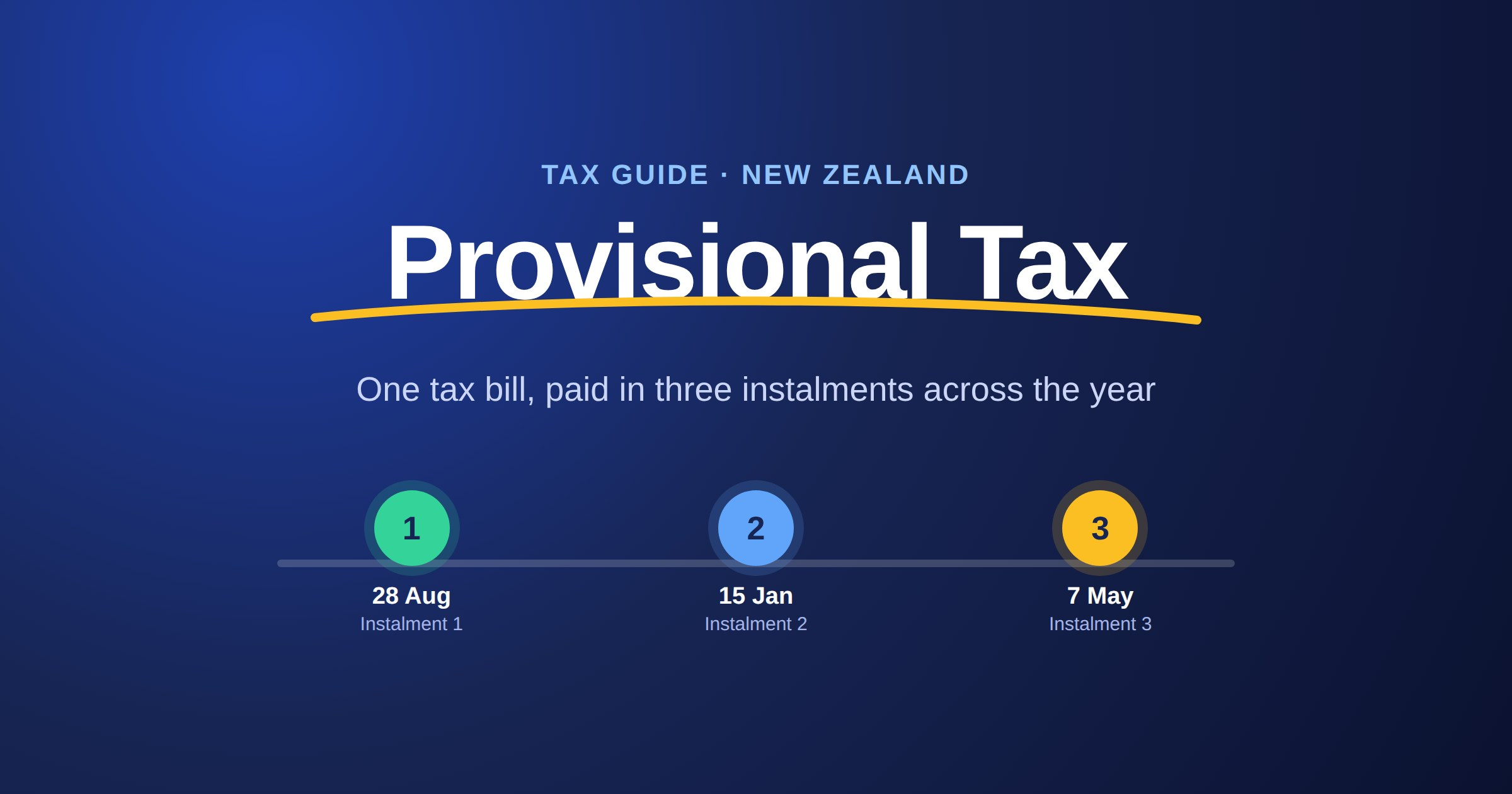
| 2-monthly, or not GST-registered | 3 a year | 28 August · 15 January · 7 May |
| 6-monthly | 2 a year | 28 October · 7 May |
| Monthly (ratio option) | 6 a year | 28 June · 28 August · 28 October · 15 January · 28 February · 7 May |
A date that falls on a weekend or public holiday simply shifts to the next working day. Six-monthly filers skip the 28 August date entirely — their two payments piggyback on their own GST due dates instead.
5. The four ways to calculate it
- Standard (uplift) — the default for most people. IRD takes last year’s RIT, adds 5%, and splits the total across your instalments (10% instead of 5% for any instalment that’s already overdue when you file late). Get it right and no interest applies, even if your actual bill ends up higher.
- Estimation. You work out the year’s tax yourself instead of using last year’s figure — useful if income is dropping, or it’s a slow first proper year and paying something beats paying nothing. Underestimate and interest accrues on the gap; overestimate and you’ve just paid early.
- Ratio (GST-registered only). Pay a fixed percentage of each GST-exclusive sales figure, aligned to your GST filing dates — six smaller payments that track your actual cash flow instead of three or two fixed-size ones.
- AIM (Accounting Income Method). Available through compatible accounting software. Tax is calculated from your real profit as you go, so a quiet month is never taxed as if it were a busy one.
6. Safe harbour and interest
If you use the standard (uplift) option and your RIT is under $60,000, IRD won’t charge use-of-money interest on a shortfall, provided you pay the uplifted amount in full and on time — even if your actual bill later comes in higher. You can still face late-payment penalties on a missed instalment, just not the roughly 10.9% p.a. interest charge.
Once RIT reaches $60,000 or more, that protection disappears: interest can apply from as early as your first instalment date if you’ve underpaid, calculated on whichever is smaller — the shortfall on that instalment, or your proportional share of the full year’s RIT still unpaid.
7. Finding it in myIR
Once you’re registered as a provisional taxpayer, your instalment dates and amounts sit inside your Income tax account in myIR, alongside your GST and any other tax types. Log in, open your Income tax account from the account list, and look for a provisional tax panel or upcoming-payments summary showing the instalment(s) still to come this year — that’s the figure you type into a business’s Settings here once each one is confirmed.
myIR also lets you switch between the standard, estimation, ratio and AIM options for next year from the same account, and shows any use-of-money interest already charged. If you can’t find it, myIR’s own search bar (top of every page) for “provisional tax” will take you straight there.
How Barnaby helps
Barnaby can work out the standard-option instalments from last year’s tax (your residual income tax plus 5%, or the year before plus 10% if last year isn’t filed yet) and split them across your due dates. IRD is still the source of truth, so check the amounts against myIR. Then it tracks them for you: a running instalments table with due dates, an income-tax-owed estimate compared against what you’ve actually paid so far, and an optional sync to your Calendar so a due date never arrives as a surprise.
See it for yourself
Track your provisional tax instalments, GST and ACC in one place, alongside a rental property if you have one.
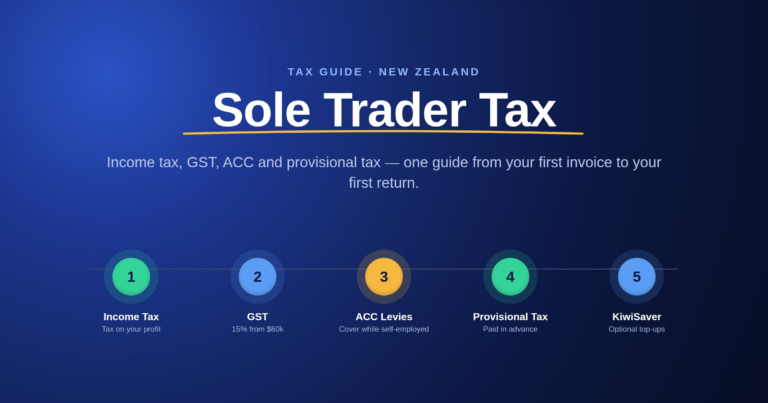
Get startedWant the bigger picture first? Read the full Sole Trader Tax in New Zealand guide, which covers income tax, GST, ACC and more alongside provisional tax.
This is general information, not personalised tax advice. Rates, thresholds and dates above are current as of September 2026 for the 2025–26 and 2026–27 tax years, and they change most years — always check current figures at ird.govt.nz or with an accountant before relying on them for a real decision.