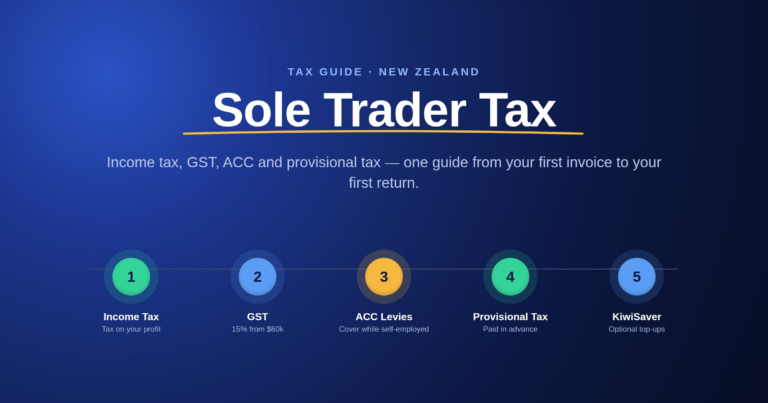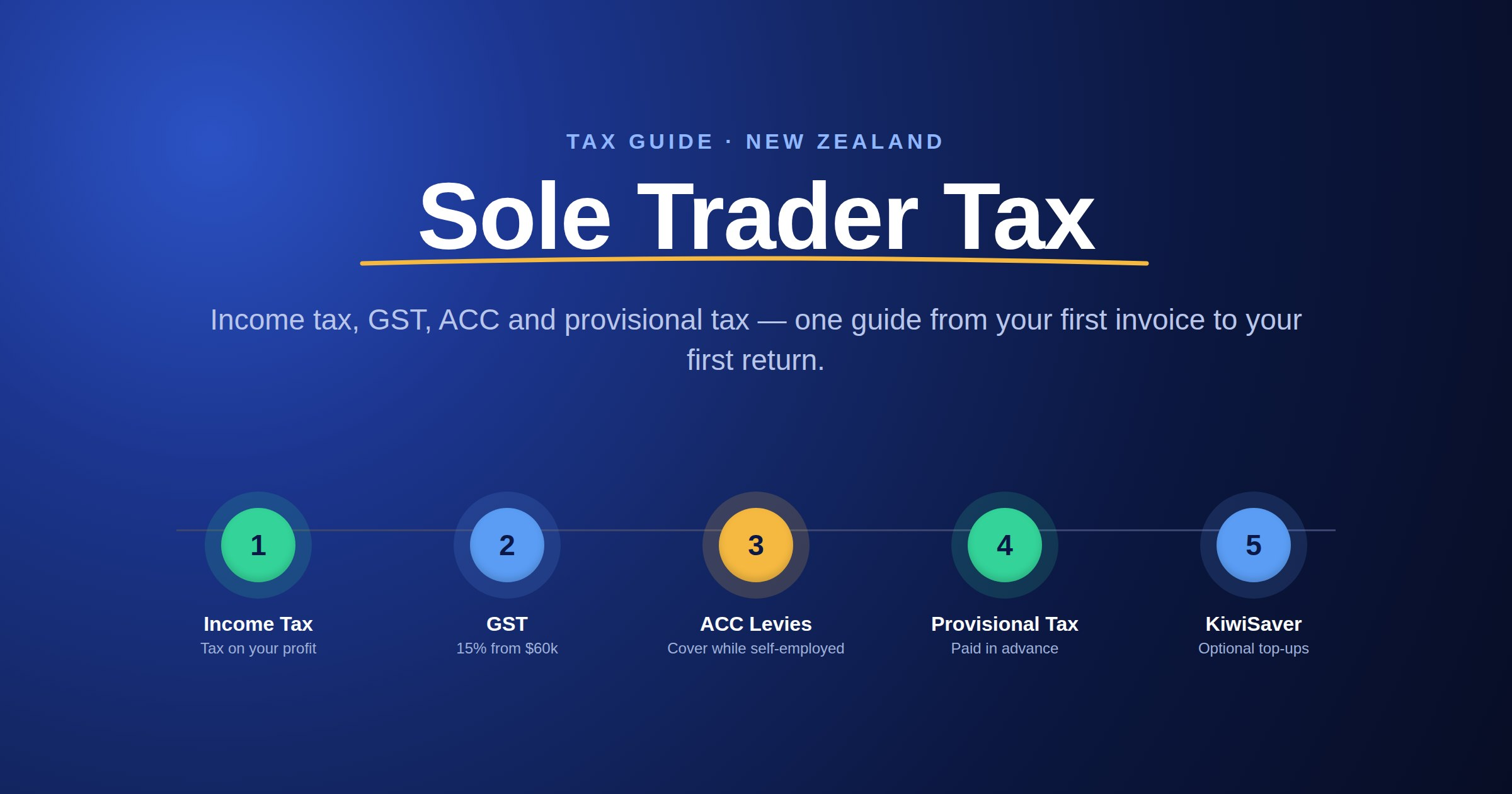
Everything you need to know about income tax, GST, ACC, and provisional tax if you’re self-employed in New Zealand — with worked examples.
If you’ve just gone out on your own — whether that’s fixing cars, doing hair, building decks, designing logos or writing code — nobody hands you a manual for the tax side of it. One day you’re an employee with PAYE quietly doing its job in the background, and the next you’re the one who has to work out GST, ACC, provisional tax and what on earth an IR3 is.
This guide walks through it all in order: what you’ll pay, what you can claim back, and the one trap that catches almost every sole trader in their second year. Figures below are current for the 2025–26 and 2026–27 tax years.
1. The basics: sole trader, IR3, and income tax
Being a “sole trader” just means you’re self-employed without a separate legal entity — no company registration, no shareholders, just you trading under your own name (or a trading name) using your own IRD number. It’s the simplest way to start, and it’s how most people in New Zealand begin.
Once you’re earning, you file an IR3 each year — an individual tax return that reports your net profit (income minus expenses), not your turnover. It’s due by 7 July following the end of the tax year (31 March), though a tax agent’s extension of time can push that out to the following 31 March.
Your self-employed profit is taxed at the same individual income tax rates as a salary or wage earner:
| Taxable income band | Rate |
|---|---|
| $0 – $15,600 | 10.5% |
| $15,601 – $53,500 | 17.5% |
| $53,501 – $78,100 | 30% |
| $78,101 – $180,000 | 33% |
| $180,001+ | 39% |
2. What actually counts as income
Your tax bracket — and whether you tip into provisional tax — is based on your total taxable income for the year, not just your self-employed profit. A few things stack together, and one common one doesn’t.
Stacks into taxable income: salary or wages from any part-time job, self-employed profit, schedular (contracting) payments, net rental income, interest and NZ dividends, and overseas income if you’re NZ tax resident.
Taxed separately: KiwiSaver growth and PIE managed fund returns are taxed inside the fund itself, at your Prescribed Investor Rate (PIR, capped at 28%). As long as your PIR is set correctly, that’s a final tax — it never gets added to your taxable income and never touches your bracket or your provisional tax trigger. Prize money, inheritances and genuine gifts don’t count as income either (though interest you later earn by investing them does).
3. The claiming test
Before getting into specific categories, it helps to know IRD’s actual test, because everything below is just this one idea applied to a different situation: does the expense help earn your business income, and does it lack significant private benefit?
If something serves both business and private life — a phone, a laptop, a vehicle — you can only claim the business-use portion. A laptop used 75% for client work lets you claim 75% of its cost or depreciation, not the whole thing.
✅ Generally claimable
- •Materials and cost of goods sold
- •Vehicle running costs (business %)
- •Home office costs (business %)
- •Business premises rent
- •Tools, equipment and software
- •Mobile and internet (business %; a dedicated business line is 100%)
- •Depreciation on business assets
- •Business insurance
- •Interest on business borrowing
- •Professional memberships and accounting fees
- •Mandated uniforms and safety gear
- •50% of most client entertainment
❌ Not claimable
- •Ordinary clothes you just happen to wear to work
- •The private-use slice of anything mixed-use
- •The other 50% of entertainment
- •Fines and penalties
- •Personal groceries and private travel
- •The full cost of an asset above the low-value threshold in one hit — it has to be depreciated instead
- •Income tax itself
- •KiwiSaver contributions — an allocation of after-tax pay, not a deduction
Keep your receipts and invoices for seven years — that’s how long IRD can come back and ask you to prove a claim.
4. Home office
If you work from home even some of the time, you get to choose between two methods each year — you can’t mix them for the same space.
Square metre rate (the simple option): IRD publishes a flat annual rate per square metre of home office space, meant to cover day-to-day running costs like power and heating. For 2025–26 that rate is $57.30 per m² (up from $55.60 the year before). You still separately work out and claim your business-use share of mortgage interest, rates and rent on top of it — but you can’t also claim other running costs or depreciation on the space under this method.
Actual cost method: work out your home office as a percentage of your home’s total floor area, then claim that percentage of your actual costs — power, insurance, rates, mortgage interest or rent — plus depreciation on office furniture and equipment.
Either way, anything that’s solely for business — a dedicated business phone line, say — is claimable at 100%, regardless of which home-office method you’re using.
Ben, a builder, works out of a converted garage that makes up 50m² of his 100m² home — half his floor area. He has two options:
- Square metre rate: 50 × $57.30 = $2,865, plus 50% of his mortgage interest, rates and rent on top.
- Actual cost method: work out 50% of his actual power, insurance, rates, and mortgage interest/rent, and claim that total instead.
5. Vehicle expenses
Same two-method choice as home office. A vehicle used only for business can claim 100% of its running costs either way; a mixed-use vehicle needs either a logbook (a representative 90-day sample is normally enough to set your business-use %) or the kilometre-rate method.
| Vehicle type | Tier 1 — first 14,000km/yr | Tier 2 — km after that |
|---|---|---|
| Petrol | $1.20/km | $0.37/km |
| Diesel | $1.30/km | $0.38/km |
| Petrol hybrid | $0.90/km | $0.24/km |
| Electric | $1.22/km | $0.23/km |
Tier 1 bundles fixed costs (depreciation, insurance, registration) with running costs across your first 14,000km of combined business and private driving each year. Tier 2 covers running costs only, beyond that. You multiply the relevant rate by your business kilometres — the alternative is a logbook plus your actual fuel, insurance, repair and WOF/rego receipts, apportioned by your business-use percentage.
6. Depreciation
Assets expected to last more than a year can’t be expensed all at once — with one important exception.
- Immediate write-off threshold: $1,000 (GST-inclusive if you’re not registered). Anything at or under this, expense it in full, straight away. Items bought from the same store on the same receipt count as one total — five $300 drills on one receipt are $1,500, so they’re depreciated.
- Investment Boost: for qualifying new assets bought on or after 22 May 2025, you can claim 20% of the cost immediately, then depreciate the remaining 80% as normal.
- Above $1,000: depreciate at IRD’s published rate for that asset type, using either diminishing value (bigger deductions early, tapering off) or straight line (even deductions every year). The total you deduct over the asset’s life is identical either way — you’re just choosing the shape of the curve, and you can switch methods between years if it suits you.
7. GST
GST sits alongside income tax, not instead of it, and it’s a separate system with its own registration rule.
- Rate: 15% on most goods and services.
- Compulsory registration: once your turnover crosses $60,000 in any rolling 12-month period (not just a calendar or tax year — it’s a moving 12-month window).
- Voluntary registration is allowed below that threshold — useful if you want to claim GST back on setup costs — but it means charging GST on every invoice you raise from then on, which can make you less competitive against non-registered competitors if your clients aren’t GST-registered themselves.
- Filing frequency: 2-monthly by default; 6-monthly is available under $500,000 turnover; monthly is required above $24 million (or optional any time, useful if you’re usually due a refund).
Once registered, you charge GST on what you sell (output tax), claim back GST on what you buy for the business (input tax), and pay or receive the difference each period.
For the full picture — worked examples, the home-office claiming trap, and how to find and change your filing frequency in myIR — see the full GST guide.
8. ACC levies
Employees have ACC quietly deducted from every payslip. Self-employed people get billed directly, once a year, after their return is filed — which is exactly why it can feel like it comes out of nowhere. Figures below are for the 2026–27 levy year (1 April 2026 – 31 March 2027), and your liable income is your net profit per your IR3, not your revenue.
| Levy | Rate | Notes |
|---|---|---|
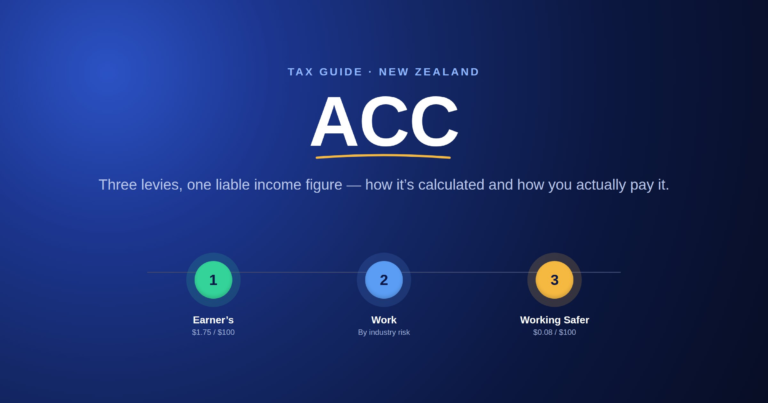
| Earner’s Levy | $1.75 / $100 | Everyone, funds non-work injury cover |
| Working Safer Levy | $0.08 / $100 | Everyone, funds WorkSafe NZ |
| Work Levy | Industry-specific | Set by your Classification Unit — e.g. Carpentry Services sits at $1.87/$100 for 2026–27, Real Estate Services at just $0.17/$100 |
Two people earning the exact same $60,000 profit can end up roughly $1,000 apart purely because of the Work Levy — riskier trades cost more to insure, and your Classification Unit (set by your BIC code) decides which rate you’re on.
There’s also a minimum liable income floor of $50,501 for anyone working full-time (averaging more than 30 hours/week across every job, not just this business) — even if you actually earned less, you’re levied as if you earned the floor amount. Part-time self-employed people have no floor and pay on actual profit. There’s a maximum liable income cap of $156,641 that applies to everyone. Your full-time/part-time status isn’t something ACC infers from your return; you need to confirm it directly with them (0800 222 776 or via MyACC for Business) if your invoice has it wrong.
9. Withholding tax (schedular payments)
If your work falls into a category IRD treats as “labour-mainly” — cleaning, agriculture and horticulture, security, freelance media, commission-based sales and similar — your payer may be required to withhold tax before paying you, much like PAYE for an employee.
You declare your chosen rate to the payer on an IR330C. The minimum is 10% for standard contractors, or 15% for non-residents on temporary work/entry visas — you can’t elect anything lower without applying for a tailored tax rate through myIR.
Whatever gets withheld counts as a credit against your end-of-year tax, exactly like PAYE does for a salaried employee — it reduces, or can even eliminate, any provisional tax you’d otherwise owe on that income. If most of your income already has tax withheld this way, you may end up with little or no residual tax left over at year-end, which can be the difference between staying out of the provisional tax system entirely and being pulled into it.
10. Provisional tax — and the trap that catches almost everyone
Provisional tax is simply income tax paid in instalments during the year you earn it, rather than as one lump sum after you file.
The trigger: you become a provisional taxpayer if last year’s residual income tax (RIT — total tax owed, minus anything already withheld) was $5,000 or more. Below that line, you just pay the full amount as a lump sum after filing.
The first-year double hit
Here’s the part that surprises nearly every new sole trader. In your first year of business, IRD doesn’t ask for provisional tax — there’s no prior year’s return to base an estimate on. If none of your clients are withholding tax from your invoices either, every dollar can arrive with nothing held back, for the entire first year.
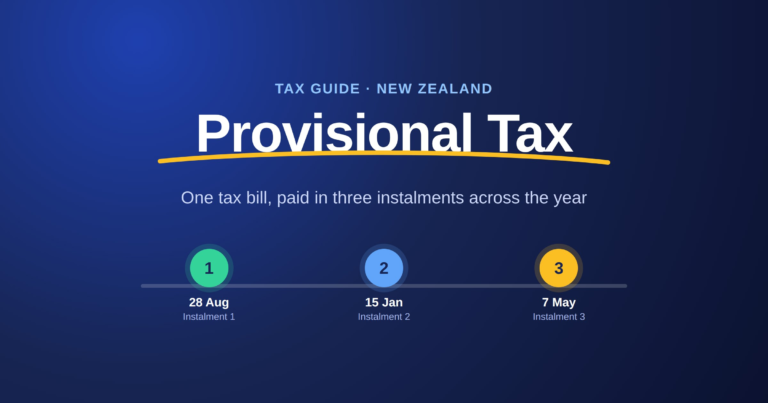
Then your first year’s tax bill (terminal tax) falls due on 7 February the following year — or 7 April if you file through a tax agent’s extension. Paying that bill, once it’s $5,000 or more, is exactly what makes you a provisional taxpayer for year two — and year two’s own instalments (28 August, 15 January, 7 May) start landing in that very same window.
Take Rawiri, a self-employed electrician in his first full year, netting $84,400. His year-one terminal tax comes to roughly $17,730, due 7 February. That same payment triggers provisional tax for year two, calculated at 105% of that figure (~$18,616, split into three instalments of ~$6,205 each) — and if the first two of those instalments were also missed earlier in the year, they land in the same window too. In a bad case, Rawiri could be looking at over $30,000 due within days, entirely from tax that was simply never set aside because nothing forced it to be, until now.
The same trap applies to student loan repayments: 12% of earnings above the $24,128 threshold is assessed in full with your first IR3, and once that obligation passes $1,000, interim repayments for year two start on the same 28 August / 15 January / 7 May dates — stacking on top of provisional tax, not replacing it.
The four ways to calculate it
- Standard (uplift) — the default for most people. Pay 105% of last year’s RIT across three instalments. Get it exactly right and IRD won’t charge interest even if your actual bill ends up higher.
- Estimation. Work out the year’s tax yourself — useful if income is dropping, or it’s genuinely your first year and you’d rather pay something than nothing. Underestimate and interest accrues; overestimate and you’ve simply paid early.
- Ratio (GST-registered only). Pay a percentage of your GST-exclusive sales, aligned to your GST filing dates instead of the fixed instalment dates — this smooths payments against your actual cash flow rather than a fixed schedule.
- AIM (Accounting Income Method). Available through compatible accounting software. Tax is calculated from your actual profit as you go, so an irregular or early-stage income isn’t taxed on money you haven’t made yet.
How Barnaby helps
Keeping track of all of the above by hand — every receipt, every category, every percentage — is the part that actually wears people down, more than any single rule above is complicated on its own. That’s the gap Barnaby is built for.
It reads your bank transactions (uploaded or synced directly) and learns how you categorise them, so your income and expenses get sorted correctly with less manual entry over time — materials, home office, vehicle, the lot, each mapped to the right claim percentage automatically. If you also own a rental property, it tracks that side of things in exactly the same way, side by side with your business, instead of you having to keep two separate systems in your head. GST and ACC are calculated from what you’ve actually entered, and a depreciation and chattels register handles the diminishing-value or straight-line maths for you rather than you working it out by hand.
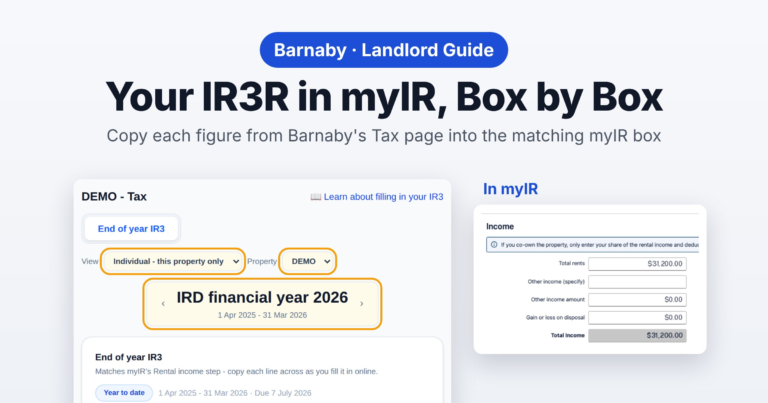
All of it comes together into every figure your IR3 needs — so instead of starting your return from a blank form, you’re copying numbers that are already worked out straight into your myIR tax return online.
See it for yourself
Track your sole trader income and expenses — and a rental property, if you have one — in one place.
Get startedThis is general information, not personalised tax advice. Rates, thresholds and rules above are current as of September 2026 for the 2025–26 and 2026–27 tax and ACC levy years, and they change most years — always check current figures at ird.govt.nz or with an accountant before relying on them for a real decision.